
FLS has completed one of its newest projects: adding a polyurethane manufacturing facility at its Tucson, Ariz., campus, positioning the site as a key global hub for the production of its advanced NexGen wear-resistant material.
This development forms part of a wider modernization program by the company aimed at strengthening supply chains, increasing manufacturing efficiency and enhancing sustainability across its global footprint.
Brad Shepherd, Director Service Line – Screen and Feeder Consumables at FLS, said the investment at Tucson aligns with the company’s global strategy to standardize and optimize production processes.
“This is a milestone for us,” says Shepherd. “We are integrating cutting-edge technology and modern manufacturing methodologies across all our polyurethane plants. This new plant enables us to respond more quickly and reliably to customer needs across North and Central America.”
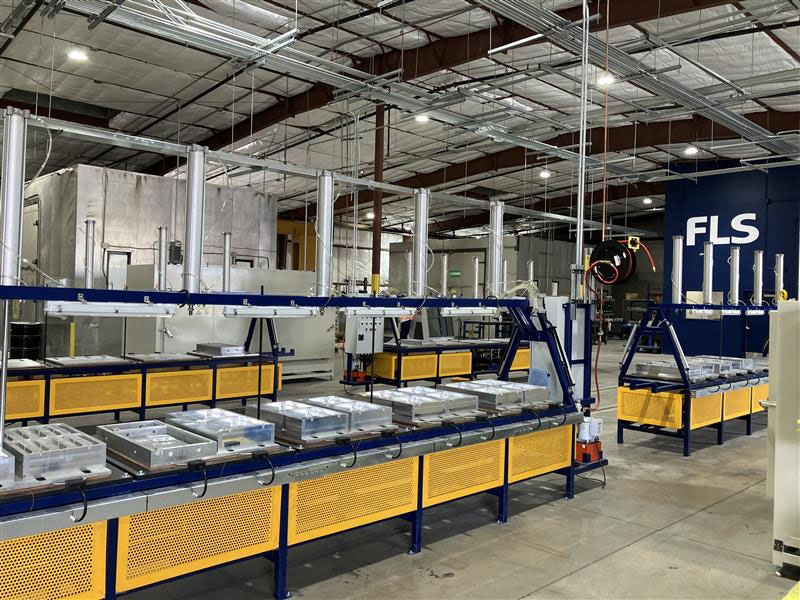
The centerpiece of the plant is the introduction of purpose-built infrastructure to produce NexGen screen media – a polyurethane material developed by FLS to deliver extended wear life, reduced maintenance and improved operational efficiency. In on-site trials, screen panels made from NexGen have demonstrated up to three times the wear life of conventional rubber and polyurethane products, making it a game-changer for industries that rely on high-performance screening solutions.
Warren Walker, Head of Global Manufacturing – Polyurethane Operations at FLS, explained that Tucson is part of the company’s five global polyurethane plants now expanding our capabilities.
“We have installed new, latest generation polyurethane machines, precision tooling and dedicated preheating ovens for inserts. This allows us to significantly increase our output while ensuring consistent quality.”
The facility now includes two trommel screen media stations and six screen media stations, each tailored to produce NexGen products. One of the standout technologies introduced is a programmable auto-calibrating polyurethane casting machine capable of adjusting material hardness to suit specific applications.
“The flexibility to produce varying hardness levels is critical,” Walker said. “It means we can tailor our screen media precisely to the customer’s application, ensuring optimum performance and longevity.”
To complement this, a high-capacity polyurethane machine is in operation at the facility. This system is particularly suited to applications requiring large volume pours, such as flotation spare parts and vertical mill components.
Energy efficiency was a key consideration in the new layout and equipment design. “We have incorporated smart energy-saving features like individual temperature control on each casting table station,” Walker said. “This avoids the need to heat large surface areas unnecessarily and contributes to our carbon reduction goals.”
FLS’s offering from Tucson extends beyond screen media manufacturing. The Tucson facility is equipped to handle warehousing, CNC machining, sandblasting, painting, assembly and product testing of the FLS pump, cyclone and valve product range. This vertical integration allows the company to deliver customized solutions with tighter control over quality and lead times.
He noted that many older processing plants are treating materials that differ from their original design specifications. In these cases, screen efficiency can often only be improved by optimizing the screen media.
“This is where NexGen makes a real difference,” Shepherd said. “Combined with the correct aperture design, it allows customers to get more life and better performance from their screens.”
Unlike injection-moulded polyurethane, which can compromise the structural integrity of screen panels, FLS’s proprietary process retains superior mechanical properties, resulting in a tougher more durable product. “We have never used injection moulding because it reduces the quality of the end product,” Shepherd explains.
“Our process delivers a product that stands up to the toughest operating conditions and offers lasting value.”
Walker adds that the expansion at Tucson not only supports FLS’s global operations but also contributes meaningfully to the U.S. economy: “Our commitment to local manufacturing is evident in the scale of our investment and the jobs we have created. We have expanded our workforce, prioritized local recruitment and significantly grown our skills development program.”
“Our investment during a period of economic uncertainty underlines FLS’s long-term commitment to the United States and to our customers across North and Central America,” says Walker. “We are not just building products – we are building skills, opportunities, and partnerships that will power sustainable growth for years to come.”
Source: fls.com